Persistent desks: stop making your agent start from zero
A stateless agent re-clones the repo, re-installs the dependencies and re-derives the same conclusions on every run. Giving it a durable workspace — a desk that survives the session — removes more failure modes than a bigger context window ever will.
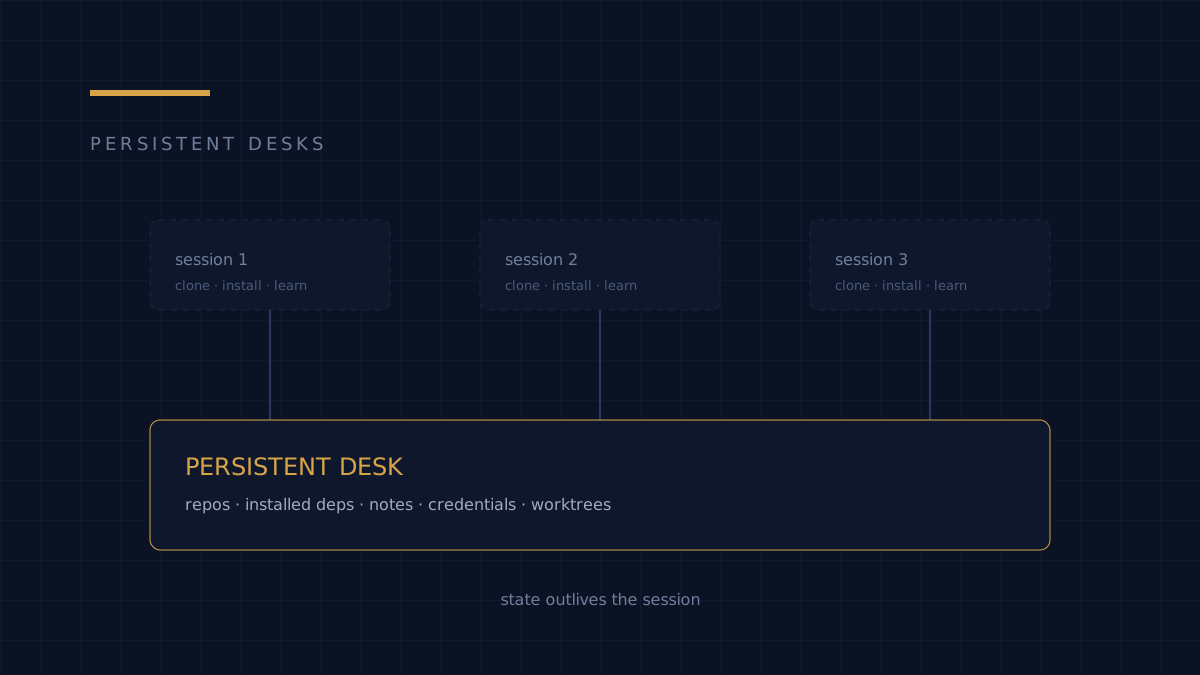
Watch a stateless coding agent work twice on the same repository. Run one: clone, install dependencies, read the project structure, discover that the test command is non-standard, fix an environment quirk, do the task. Run two: clone, install dependencies, read the project structure, discover the same non-standard test command, hit the same environment quirk, do the task.
Everything except the task itself was rework. And the second run is not just slower — it is worse, because the agent burned attention rediscovering context instead of spending it on the problem.
The naive fix is memory, and it does not work
The instinctive response is to give the agent memory: a vector store of past runs, a summary file, a larger context window. I have built all three. They help at the margins and they miss the point.
The thing a working agent accumulates is not primarily knowledge. It is state:
- an installed toolchain that took four minutes and one network flake to get right
- a cloned repository with the right branches and a warm build cache
- a virtualenv or
node_modulestree that matches the lockfile - an authenticated CLI session
- a half-finished worktree from a task that was interrupted
None of that fits in a context window, and none of it is recoverable by remembering harder. Retrieval gives an agent the sentence "the tests need a local Postgres". A desk gives it a machine where Postgres is already running.
The persistent desk
A persistent desk is a durable workspace bound to an agent identity rather than to a session. Same path every time, same contents as when the last session ended, surviving restarts and redeploys.
In practice that means a handful of conventions:
- A stable root directory that the agent knows is its own.
repos/for long-lived checkouts, so the expensive clone happens once.notes/for things the agent writes to its future self — decisions, gotchas, plans in progress.- A manual at the root describing the environment: what is installed, what is not, which shortcuts exist. The agent reads it at the start of a session and updates it when the environment changes.
- Dependencies installed on the desk, never in a container layer that resets.
The result is an agent whose first minutes are useful instead of ceremonial.
Second-order effects
The interesting part is not the saved minutes. It is what a desk makes possible.
Resumability. An interrupted task leaves artefacts on disk. A new session can look at the worktree, read the notes and continue instead of restarting. Long jobs stop being all-or-nothing.
Honest self-documentation. When an agent knows its notes persist, writing them down has a payoff. Session summaries stop being theatre and start being infrastructure.
Cheaper context. Instead of stuffing a project description into every prompt, the agent reads the desk manual on demand. Context becomes something the agent fetches, not something you pre-load.
Real tool state. Authenticated CLIs, warm caches, generated fixtures — all the things that make a human developer fast, made available to an agent for the same reason.
What breaks
Persistence is not free, and the failure modes are specific.
Concurrency. The moment two instances of the same agent share a desk, they will edit the same file. The fix is boring and mandatory: every task gets its own git worktree, never the shared checkout. Without that rule, a desk turns into a merge conflict with a filesystem attached.
Drift. A desk accumulates junk: abandoned branches, stale virtualenvs, half-downloaded artefacts. Something has to clean up, and "the agent will remember to" is not a plan. Bake tidy-up into the end of a task, not into good intentions.
Stale beliefs. A desk manual that lies is worse than no manual. If the agent installs a tool, the manual has to change in the same session, or the next session will confidently do the wrong thing.
Blast radius. A durable workspace with authenticated sessions is a durable target. Desks want the same isolation you would give a build server: one identity, scoped credentials, no shared secrets between agents that do not need them.
Why this is infrastructure, not a feature
Most agent frameworks treat the workspace as a temporary directory — an implementation detail of a run. That choice quietly decides what your agents can be. Ephemeral workspaces produce agents that answer questions. Persistent workspaces produce agents that maintain things: a repository, a pipeline, a backlog, a service.
If you want the second kind, the desk is not an optimisation you add later. It is the first thing you build.